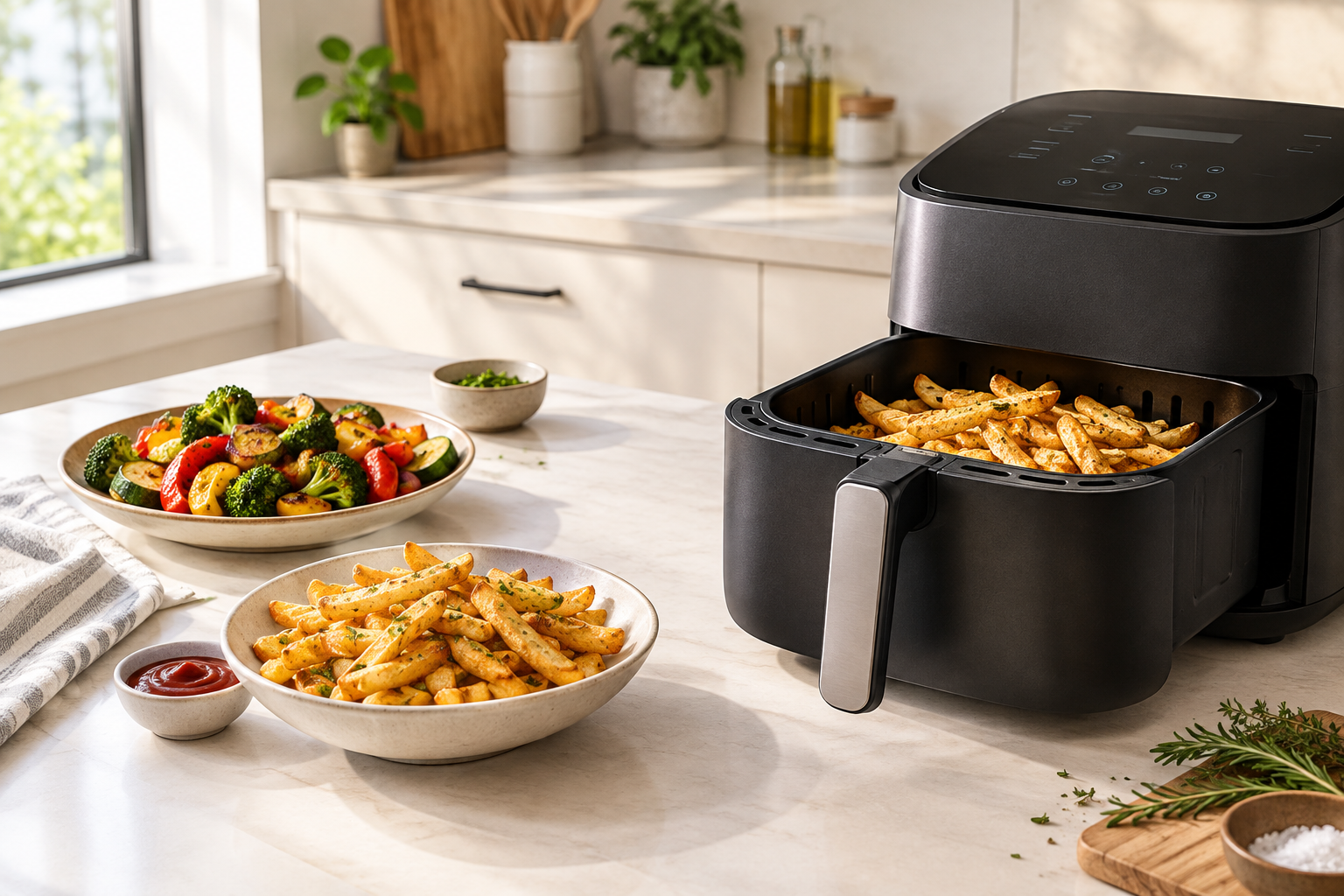
Start with the foods you actually cook
Most everyday air-frying lives in a relatively narrow band of temperatures. That means a machine advertising an unusually wide range is not automatically better for fries, wings or vegetables. The wider range becomes interesting when you also use roast, reheat, dehydrate or proofing-style tasks.
A higher maximum is not the whole story
A high maximum temperature can be useful for recipes that call for intense heat or crisping, but maximum temperature alone does not determine browning. Airflow, food moisture, loading and cook time also matter. Treat the top number as a capability boundary, not a performance score.
A lower minimum can expand the category
Very low settings can be relevant for dehydration or proofing on models that explicitly support those tasks. If you never use those functions, the lower limit may have little practical value. The right question is whether the range unlocks a task you will actually perform.
Temperature range vs temperature accuracy
Published range tells you what the control system is designed to select. It does not tell you how closely the chamber tracks that set point under every load. Accuracy and cycling behavior require testing or detailed manufacturer evidence, so GlanceM does not infer them from the range alone.
A simple buying test
List three non-air-fry tasks you might use: reheating pizza, roasting vegetables, dehydrating fruit, proofing dough, or another real task. If none benefits from a wider range, prioritize basket geometry, controls and cleanup instead.
Common mistakes to avoid
- Choosing capacity from household size alone.
- Treating wattage as a direct measure of cooking performance.
- Comparing product families without matching the exact model variant.
- Ignoring counter clearance and drawer travel.
- Reading retailer highlights without checking the manufacturer manual.
Frequently asked questions
Does GlanceM test every product?
These research pages do not claim hands-on testing unless a page explicitly documents a test. Published specifications and manuals are identified as the evidence layer.
Why focus on workflow?
Because a specification becomes useful only when it changes a recurring task: batch size, intervention, placement, cleaning or control.
Should I trust a product’s advertised capacity?
Use it as a starting point, then check basket shape, food spacing and manufacturer loading guidance.
What is the final verification step?
Confirm the exact model number, dimensions, included accessories and current manual before purchase.
How GlanceM researches this topic
A practical checklist
Research note
GlanceM treats manufacturer specifications as the evidence layer and translates them into everyday scenarios. We do not claim laboratory performance from a specification alone.
Before buying, verify the exact model number, regional version, dimensions and included accessories on the manufacturer’s current materials.