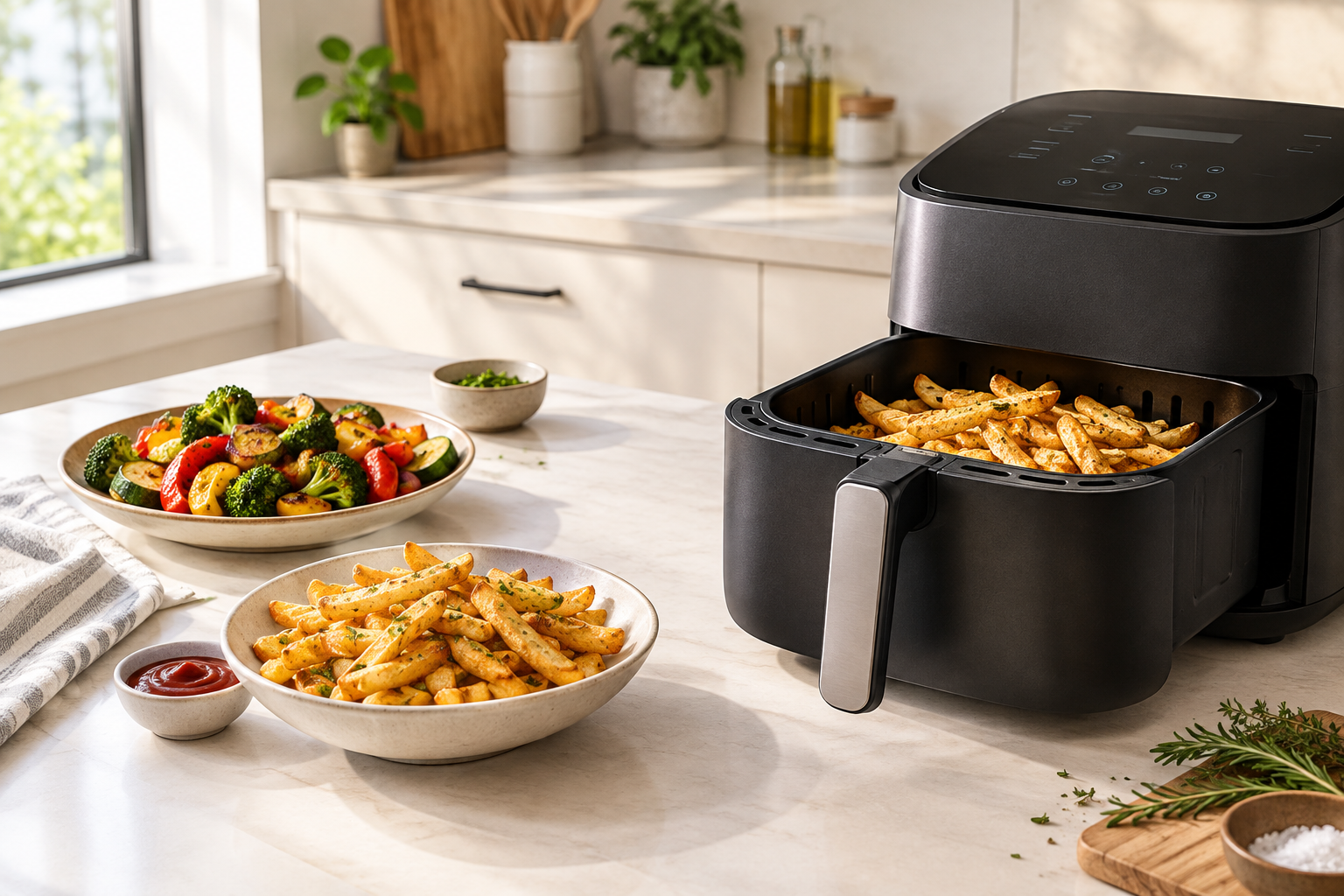
Volume is not the same as usable surface
Capacity describes three-dimensional volume. Crisping often benefits from spreading food across a surface with airflow around individual pieces. A deep basket can have plenty of volume while still forcing you to stack food for certain meals.
Think about your repeat meals
If you mostly cook wings, fries, vegetables or breaded foods, ask how much of the food you can spread without crowding. If you cook tall foods or whole small items, height may matter more. Your recurring recipes determine which dimension is valuable.
Basket geometry changes shaking
A wider basket can make it easier to toss food without digging through a deep pile. A narrower or deeper basket can change how you interact with the load. Neither geometry is universally superior; the point is that the physical workflow is hidden by the quart label.
How to compare without a laboratory
Use published basket dimensions when available, inspect product manuals for loading guidance, and look at the actual basket opening. Do not estimate usable capacity from exterior dimensions. For a practical comparison, think in terms of how many pieces of your most common food fit in one layer.
The GlanceM rule
When two models are within the same capacity class, stop treating the quart number as decisive. Move your attention to the basket footprint, opening, crisper-plate shape and the amount of food you normally cook at once.
Common mistakes to avoid
- Choosing capacity from household size alone.
- Treating wattage as a direct measure of cooking performance.
- Comparing product families without matching the exact model variant.
- Ignoring counter clearance and drawer travel.
- Reading retailer highlights without checking the manufacturer manual.
Frequently asked questions
Does GlanceM test every product?
These research pages do not claim hands-on testing unless a page explicitly documents a test. Published specifications and manuals are identified as the evidence layer.
Why focus on workflow?
Because a specification becomes useful only when it changes a recurring task: batch size, intervention, placement, cleaning or control.
Should I trust a product’s advertised capacity?
Use it as a starting point, then check basket shape, food spacing and manufacturer loading guidance.
What is the final verification step?
Confirm the exact model number, dimensions, included accessories and current manual before purchase.
How GlanceM researches this topic
A practical checklist
Research note
GlanceM treats manufacturer specifications as the evidence layer and translates them into everyday scenarios. We do not claim laboratory performance from a specification alone.
Before buying, verify the exact model number, regional version, dimensions and included accessories on the manufacturer’s current materials.