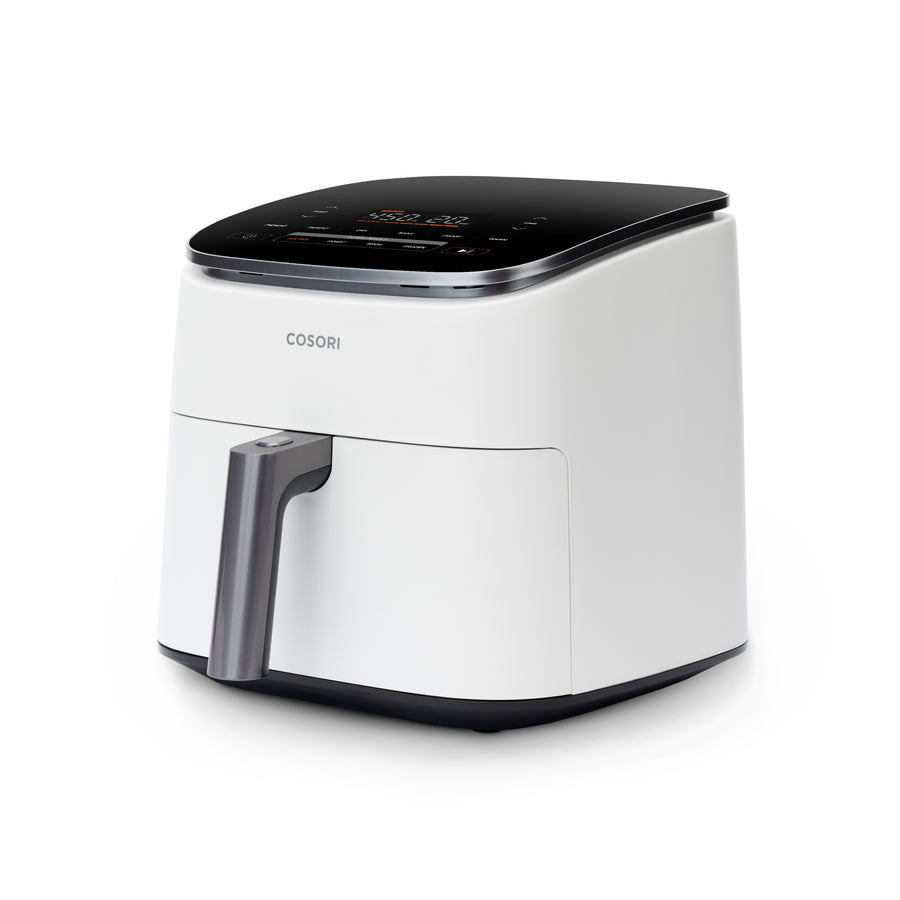
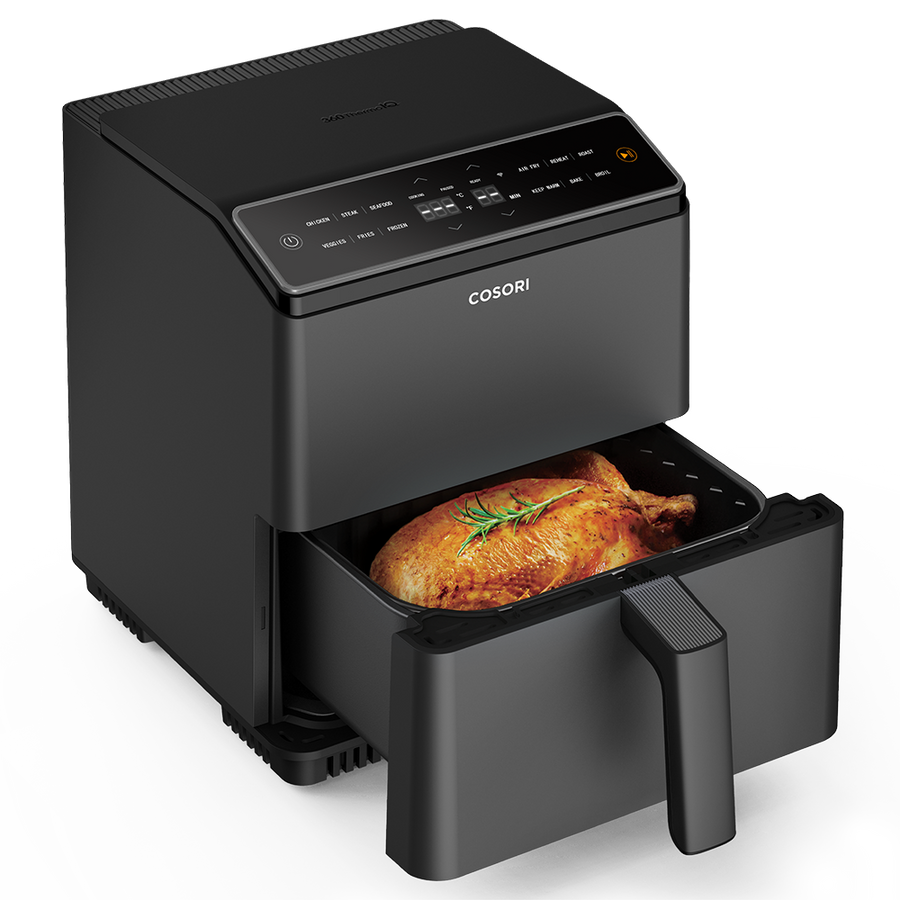
At a glance
| What matters | TurboBlaze | Dual Blaze |
|---|---|---|
| Capacity | 6 qt / 5.7 L | 6.8 qt / 6.4 L |
| Rated power | 1,725 W | 1,750 W |
| Temperature range | 90–450°F | 175–400°F |
| Heating / airflow design | DC motor, 5 fan speeds | Dual heating elements + automatic temperature control |
| Cooking programs | 9-in-1 on the dark-gray model used here | 12 functions |
| Smart control | Varies by TurboBlaze version | VeSync app + voice control |
| Dishwasher-safe parts | Yes | Yes |
What actually changes in daily use?
The TurboBlaze specification is unusually explicit about airflow: COSORI lists a DC motor and five fan speeds. That gives the appliance more ways to adjust how air moves around food, alongside its 90–450°F range. Dual Blaze takes a different route. Its upper and lower heating elements are paired with automatic temperature control, with COSORI describing the design as reducing the need to shake or flip food.
Those are different kinds of flexibility. One is about controlling the cooking environment; the other is about reducing hands-on intervention.
Scenario matrix
| If your routine looks like… | What to inspect first | Why |
|---|---|---|
| You experiment with roasting, baking or low-temperature tasks | Temperature range and airflow controls | The broader range can matter more than nominal capacity. |
| You mostly cook proteins and want less shaking | Heating layout and control strategy | Dual heating is intended to reduce the need for manual intervention. |
| You cook larger single batches | Basket shape and usable surface | 6.8 qt vs 6 qt is meaningful context, but volume alone does not describe usable cooking area. |
| Your counter is tight | Full dimensions and handle clearance | Capacity gains only help if the appliance fits where you use it. |
The hidden difference: temperature range is not the same as cooking performance
A 90–450°F range gives TurboBlaze a wider nominal control window than Dual Blaze's 175–400°F range. That does not, by itself, prove faster cooking, better browning or more even results. Those are performance questions that require testing or manufacturer evidence beyond the range number.
What the extra capacity does — and does not — tell you
Dual Blaze is 0.8 qt larger on the manufacturer's advertised capacity. That can help when a batch is close to the limit, but food spacing still matters. A larger volume can be especially useful for tall foods or larger quantities; it is less decisive if you normally cook one small batch.
3-minute decision
- Choose the TurboBlaze research path if your first question is about temperature range, airflow control or low-temperature flexibility.
- Choose the Dual Blaze research path if your first question is about dual-element heating, automatic temperature control or a slightly larger nominal capacity.
- Before buying, confirm the exact model/variant because TurboBlaze versions can differ in smart features and advertised capacity.
GlanceM Research Notes
Manufacturer-stated: capacity, wattage, temperature range, functions and heating design are taken from current COSORI product materials.
GlanceM interpretation: we translate those specifications into workflow implications rather than treating any one number as a universal performance score.
Sources & verification
Prices, availability, regional variants and bundles can change. GlanceM does not treat a temporary retailer price as a permanent product characteristic.